

Nursery tracing worksheet — free printable pre-writing lines PDF
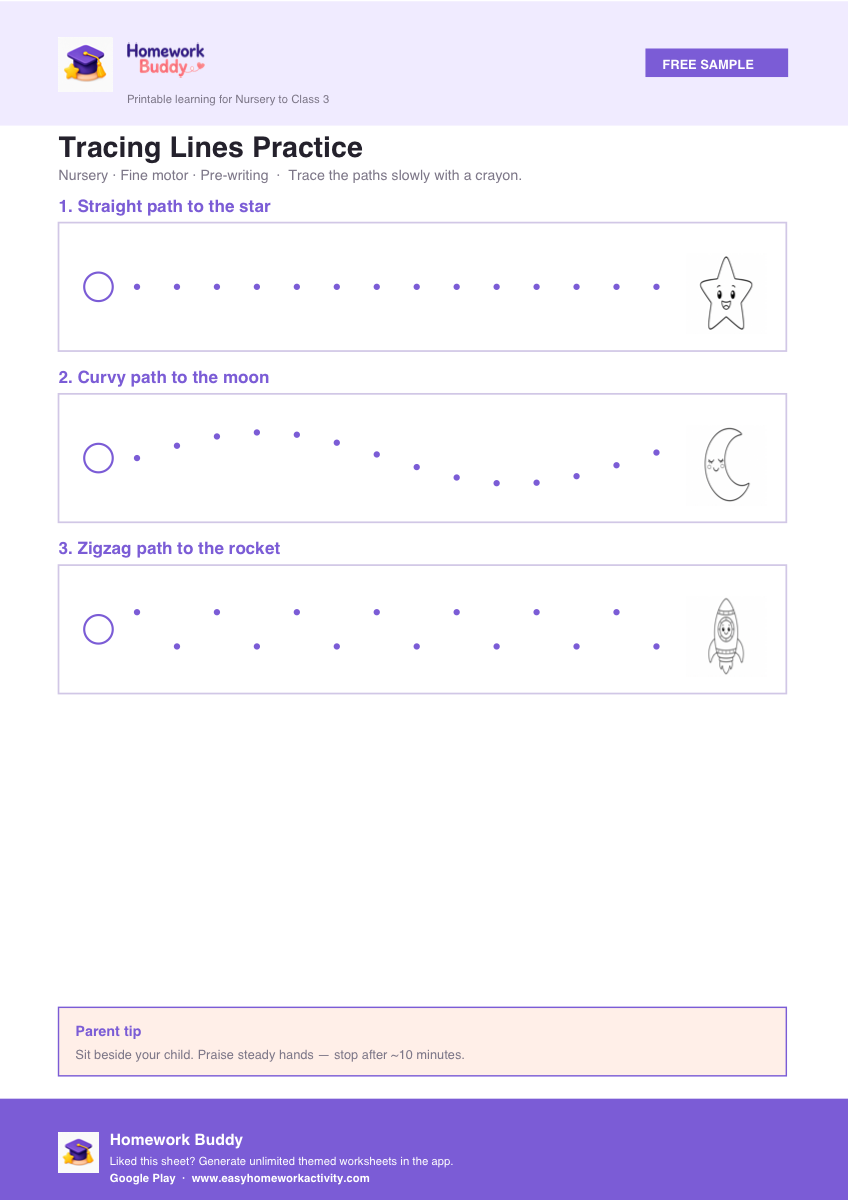
Nursery homework tracing worksheet with straight, curvy, and zigzag paths for pencil grip practice.
Free printable PDF
Download “Tracing Lines Practice”
Nursery homework tracing worksheet with straight, curvy, and zigzag paths for pencil grip practice. Preview the complete sheet below, then download and print it without signing up.
Tip: After you print this sheet, open Homework Buddy to create a matching activity with a new theme in minutes.
Related hubs
What's on this sheet
- Straight horizontal tracing paths with start dots
- Curvy wave lines for smooth wrist movement
- Zigzag paths for direction changes
- Large spacing suited to Nursery pencil grip
Pre-writing lines help Nursery children build pencil control before letters. Trace slowly and praise steady hands.
Age fit: Best for Nursery (roughly 3–4 years) when your child can sit for a few minutes and hold a crayon with a whole-hand or emerging tripod grip. If they still fist-grip everything, that is fine — tracing builds the habit before letter worksheets.
Ten-minute session script: Snack first, then say, “We are training our pencil like a little car on a road.” Trace one line together, let them do two alone, clap once, and stop. In many Indian homes this fits between bath time and dinner without feeling like ‘real homework’.
Common mistakes: Pressing so hard the crayon snaps; racing to the end; skipping curves because zigzags feel hard. Another parent trap is printing two pages at once — one side is enough for Nursery.
When to stop: Put the sheet away if shoulders hunch, the free hand stops stabilising the paper, or tears start. A calm half-page today beats a full page with frustration.
Indian context tip: If your playgroup uses cursive-style pre-writing, this sheet still helps — the paths are neutral. Pair with Hindi swar tracing on alternate days rather than stacking both on one tired evening.
How to use this worksheet
- Print on A4 with no scaling — lines should feel wide enough for a thick crayon or short pencil.
- Let your child pick the colour; say “slow and steady” before the first straight line.
- Demo one path with your finger in the air, then one on paper — stop after that if they want to try alone.
- Praise grip and focus, not perfection. Wobbly lines are normal at Nursery age.
- Stop after 8–10 minutes or when the hand looks tired — save zigzags for another day.
Frequently asked questions
Is tracing good nursery homework?
Yes — short tracing sheets are ideal nursery homework when sessions stay playful and under about 10 minutes.
Should Nursery children use pencil or crayon for tracing?
Start with a thick crayon or wax crayon — less pressure, less frustration. Move to a short pencil when lines stay mostly on the path for two sessions.
My child traces outside the lines. Should I reprint?
No. Wobble means the hand is learning. Use praise for effort; repeat the same sheet after a day or two if they enjoy it.
How often should we do tracing homework in Nursery?
Two or three short sessions a week is plenty alongside free drawing and outdoor play.
Can I laminate this tracing sheet for reuse?
Yes — a sleeve and whiteboard marker works well for car rides or balcony time before monsoon evenings indoors.
Educational disclaimer: Content is for general parent guidance and practice ideas. Follow your school's curriculum and teacher advice. Last updated: 1 September 2026. Editorial review: Homework Buddy content team.